Check out these useful video clips, especially the 2nd one on how to change fuel filter:
http://www.cincitdi.com/richc/
Thursday, March 13, 2008


Tuesday, March 11, 2008
Benefits of growing canola for fuel AND food
Here's a post from Becky a farmer in E. WA:
I'd like to add a little firsthand info here as to growing BD feed stocks. We're farmers in Eastern Washington. We grew 260 acres of canola last year and had another 260 acres planted for 2008. I drive a VW Passat diesel and a 1999 Ford F-350 diesel (when I have to have the pulling/hauling power) running 100% Washington grown canola oil BD (except during the winter when I have to blend) in both of them. I pay full price for my canola BD and will continue to do so to support my local BD processor and the local Eastern Washington economy.
Our canola is grown with minimal inputs, no pesticides and supports a huge number of honeybee hives for local apiaries during the June bloom, which greatly improves their health and general wellbeing. And for those thinking the land used to grow this canola is taking away from other food crops, it's not. It's grown on ground that would otherwise be left empty, or fallow, producing nothing. So, we're not reducing food production at all on our farmland...we're increasing it. The canola meal is a highly sought after feed for all kinds of livestock from cattle, milk cows, poultry, etc.. In fact, the dairy farmers absolutely love it because it increases the butter
fat and omega3 fatty acids in their milk.
Just thought some of you might be interested with what some of your
Washington farmers are doing.
She added this later:
The honey bee industry is in really big trouble right now due to unexplained diseases and losses in hives all over the world. It is critical to the health of the bees to have a large, highly nutritious source of pollen and nectar to recover from being hauled down to California and back up during the fruit and nut pollination season. The canola provides that critical need at just the right time.
I'd like to add a little firsthand info here as to growing BD feed stocks. We're farmers in Eastern Washington. We grew 260 acres of canola last year and had another 260 acres planted for 2008. I drive a VW Passat diesel and a 1999 Ford F-350 diesel (when I have to have the pulling/hauling power) running 100% Washington grown canola oil BD (except during the winter when I have to blend) in both of them. I pay full price for my canola BD and will continue to do so to support my local BD processor and the local Eastern Washington economy.
Our canola is grown with minimal inputs, no pesticides and supports a huge number of honeybee hives for local apiaries during the June bloom, which greatly improves their health and general wellbeing. And for those thinking the land used to grow this canola is taking away from other food crops, it's not. It's grown on ground that would otherwise be left empty, or fallow, producing nothing. So, we're not reducing food production at all on our farmland...we're increasing it. The canola meal is a highly sought after feed for all kinds of livestock from cattle, milk cows, poultry, etc.. In fact, the dairy farmers absolutely love it because it increases the butter
fat and omega3 fatty acids in their milk.
Just thought some of you might be interested with what some of your
Washington farmers are doing.
She added this later:
The honey bee industry is in really big trouble right now due to unexplained diseases and losses in hives all over the world. It is critical to the health of the bees to have a large, highly nutritious source of pollen and nectar to recover from being hauled down to California and back up during the fruit and nut pollination season. The canola provides that critical need at just the right time.
Sunday, February 17, 2008
Japanese Biodiesel Around-theWorld Adventure


Yesterday we (our coop- Dirty Hands & Madrona) hosted the team from Japan as it begins it's adventure, making biodiesel from donated waste veggie oil as they go. I've had a great time hanging out with them- Shusei, Satori, and Tatsu. Shusei Yamada had the idea and designed the elaborate and beautiful processor, which amazingly fits in the back of the Toyota Landcruiser. It's on a track so it can slide out and allow for adding oil and chemicals. Shusei is no stranger to around the world adventures or biodiesel. He works as a photojournalist, and is also an off-road racer. He's crossed the Sahara on motorcycle, raced the United Arab Emerites Desert Challenge in a car using biodiesel, and has travelled to 140 countries. And he's a really nice guy! Very down to earth, so to speak, gentle and warm-hearted- he seems to really enjoy meeting folks while doing this amazing thing to raise awareness about the need for alternative and environmentally friendly fuels. The launching ceremony was great fun- see today's story in the Seattle PI.
They'll be heading south to LA, and then east- if you'd like to contact them and help them with publicity and most importantly oil donations, reply to this post, or email me at biolyle@gmail.com and I'll put you in touch with Satori, the team's wonderful organizer. And now for some pics! Yes they use ion exchange resin for washing, so no water...
Friday, January 25, 2008
Methanol sources
| Washington | |||
| Tarr, Inc 4510 B St NW # B Auburn, WA 98001 | 253-859-2979 | KOH, Methanol | Map It |
| Advanced Toys for Trucks 12803 Hwy 99 Everett, WA | 425-485-3682 | Methanol | Map It |
| G&M Honest Performance 33210 Pacific Highway South Federal Way, WA, 98003 | 253-838-7070 | Methanol | Map It |
| Wilcox & Flegel 940 Industrial Way Longview, WA | 360-423-7600 open 7:30-6:00 | Methanol | Map It |
| Cascade Columbia Distribution Co. 6900 Fox Ave. S. Seattle, WA. 98108 206-763-2350 | KOH, | Methanol | , sulfuric acid |
| Ronald G. Grogan CHEMCENTRAL 6308 E. Sharp Ave. Spokane Valley, WA | 866-885-2605 | Methanol | Map It |
| Pacific Coast Chemicals 530 Andover Park West Tukwilla, WA 98188 | 206-223-0006 | KOH, NaOH | |
Monday, January 14, 2008
Oilseed Fun in Montana


As a city slicker, I'm used to finding my oil ready made (ie in the oil dumpster out back of the restaurant). A missing piece for me has been how's that stuff get produced to begin with. At the MSU Oilseed & Biodiesel Conference in Billings last week, I learned a thing or two about farmin', crushin', and doin' some real work! This day and a half conference was excellent, complete with the perspective of the farmers, the scientists (featuring world-renowned biodiesel expert Jon van Gerpen from Univ of Idaho biodiesel ed program), economists, and government officials. My favorite presentations were by a rancher Ken deBoer who with little previous farming experience, decided he wanted to try and grow his own fuel. He planted camelina seed on two lots that he said were bad and really bad as far as soil quality. And without watering or fertilizing he was able to actually get plants to grow, gathered seed, crushed it and produced some oil- about 14 gallons from his two 1/2 acre lots (and 500 lb of seed). His yield was only about 350 lb per acre, which is low compared to the 1000+ lb some have achieved. His one-ton crusher was real slow (and is now for sale!), and he learned a lot of other things about the process. Another speaker pointed out that you can save yourself a lot of time and money if you use a bigger crusher and just get the job done faster.
Interesting fact- the cake from camelina crushing is highly nutritious with very high protein content- cows love it!
The presentations from this and other Montana biodiesel workshops are now online here.
After the workshop, we visited a farm where they had an oil seed press up and running. They were still breaking the crusher in, with not a lot of oil coming out yet. Apparently the crushing screw has to be worn smooth before it becomes very efficient. Their operation looked very Rube Goldberg and kinda like a scene from the movie Brazil- with the steam billowing out (used to heat the press), and the separate motor galloping along, with long drive belts flapping about. Check out the short video of these intrepid crushers: by the way, the crusher is from tinytechindia.com
Here's the you tube crushin' vid..
Happy crushin'...
BioLyle
http://biolyle.com
Wednesday, January 02, 2008
Eathrace ship trying for around-the-world record on biodiesel

Talk about committment! Not only are they spending millions on the record attempt, but the captain and some of the crew even underwent liposuction to contribute some fuel from their own bodies to the effort- see this article and nice short video promo: http://blog.wired.com/cars/2007/12/around-the-worl.html
I was on the boat when it visited Seattle last year- it is amazing!
Saturday, December 29, 2007
New test for total glycerin
b100supply.com has a new field test for total glycerin level in your fuel. The ASTM spec says glycerin contamination should not exceed 0.24%, so you can use this test to get a ball park idea of whether your fuel is in spec. The 3/27 or methanol test is an even simpler and cheaper way to see if your fuel is likely to be in spec, as it seems to fail when fuel tests higher than about 0.24%. You might use the new glycerin level test along with 3/27 to see how they compare. Since glycerin contamination is usually the culprit when folks have fuel filter plugging problems, testing for glycerin is probably the single most important quality test to do. But make sure your fuel doesn't have water in it either!
Tuesday, December 18, 2007
City of Daphne using a BioPro to recycle veg oil into biodiesel
Here's a great example of how a small city is using a BioPro190 biodiesel processor to turn waste veg oil into fuel! This post compliments of Graydon Blair of Utah Biodiesel Supply..
Daphne Public Utilities - Daphne, Alabama
http://daphneutilities.com/daphne/recycle_bio.htm
The city of Daphne Alabama purchased a BioPro 190 earlier this year as a show piece for their oil recycling program. Citizens of Daphne, Alabama are encouraged to drop off their waste vegetable oil at designated drop off stations placed throughout the city. The oil is collected, filtered, and then processed into Biodiesel by the city in their brand new BioPro 190.
Recently I had a chance to follow up with them to see how they were enjoying it and they were extremely ecstatic about it. They said they were really impressed with how easy it was to use. All of their staff involved in the program really like using it & seeing how quick they can make a batch.
Prior to having a BioPro, they had more cumbersome equipment that they used to make their Biodiesel with. They said that using the BioPro is so much easier and more effective.
So much more effective that they'll be taking it on the road soon on a tour of several other municipalities in Alabama to show just how easy it is to create a city wide oil recycling program. Get this! They even recycle the glycerin and turn it into soap! So not only are they recycling waste oil which may have ended up in their sewer system, they now make biodiesel to power the city trucks and recycle the glycerin and make soap which they sell as well! How's that for being environmentally responsible!
Daphne Public Utilities - Daphne, Alabama
http://daphneutilities.com
The city of Daphne Alabama purchased a BioPro 190 earlier this year as a show piece for their oil recycling program. Citizens of Daphne, Alabama are encouraged to drop off their waste vegetable oil at designated drop off stations placed throughout the city. The oil is collected, filtered, and then processed into Biodiesel by the city in their brand new BioPro 190.
Recently I had a chance to follow up with them to see how they were enjoying it and they were extremely ecstatic about it. They said they were really impressed with how easy it was to use. All of their staff involved in the program really like using it & seeing how quick they can make a batch.
Prior to having a BioPro, they had more cumbersome equipment that they used to make their Biodiesel with. They said that using the BioPro is so much easier and more effective.
So much more effective that they'll be taking it on the road soon on a tour of several other municipalities in Alabama to show just how easy it is to create a city wide oil recycling program. Get this! They even recycle the glycerin and turn it into soap! So not only are they recycling waste oil which may have ended up in their sewer system, they now make biodiesel to power the city trucks and recycle the glycerin and make soap which they sell as well! How's that for being environmentally responsible!
How to break an emulsion
Here's a great post about how to use salt to break biodiesel emulsions formed when washing the fuel.
Kuma Stove warmth!
Came home from skiing in Canada on Sunday to a house that was stone cold. Fired up the Kuma stove, and now the whole house is warm and cozy.. Check out the nice flame it puts out in this 10 second video..
Saturday, December 01, 2007
Coop open house for Biznik members


The snow started falling right about when the open house started today. This event was open only to members of Biznik, which is a great online networking community. Only a few people braved the snow today, but with some hot cider and interesting conversation we managed to have a good time.. Check out the snow in Seattle!
Sunday, November 11, 2007
Building a processor with High School students

Had fun doing a processor build workshop with kids from Kamiak High School a couple weeks ago. The workshop was held in the diesel lab at the Sno Isle Skills Center in Mukilteo, WA, which the district uses to teach kids diesel mechanics- wish I could take the class! We had 7 students along with the chemistry teacher, John, and the diesel mechanics teacher Brent, who was a great asset- showing us their big diesel engines and explaining how they work. He also helped get the darn zinc anode out of the water heater with his air impact wrench when all else had failed!
They had ordered the b100supply Appleseed kit, so it seemed like it'd be no problem, except that they had gotten a gas water heater to start with, and that wouldn't do! So we started out the day with Brent and John rounding up an electric one- with amazing speed! - while I went over biodiesel basics with the kids.
Once we got the right water heater, and got that anode out, the rest was easy- we even made a 16 gallon batch using some of the waste fryer oil from the cafeteria..
Check out the pics from the day here:
http://picasaweb.google.com
BioLyle's Biodiesel Workshop
http://biolyle.com
BioPro 190 fuel passes full ASTM series
The state of WA donated a complete ASTM test series for the fuel that we're producing with our BioPro 190, as you can see from the results on my fuel quality page here: http://biolyle.com/biopro/quality%20biopro%20fuel.html
that it passed nicely.. Total glycerin of 0.149 this time- we had that done a couple months ago and it was 0.122..
I do an overnight preheat of the oil in the machine to dry it which I think helps improve the reaction.. Am really psyched that we can produce such great fuel consistently.. Our oil usually titrates pretty low- 2 - 3 or so..
I love this machine!
Lyle
http://biolyle.com
Thursday, November 08, 2007
Join Biznik!
I've been having fun with biznik, an online business networking community.. They also have all kinds of events where folks can meet each other, exchange ideas, and make valuable connections. I've gone to events the last two nights and met some great people. I'd recommend it to anyone who has any kind of business!
Sunday, October 21, 2007
recent articles/ Bioneers conference/Mushrooms!
The Everett Herald did a nice little article about my class at the college there yesteday:
Also, National Geographic did a Biofuels piece, with some material on biodiesel from algae.. Sounds like it's still a ways off from commercial availability.
Heard Paul Staments speak at Seattle Bioneers conference yesterday- haven't been so blown away by a talk in a long time. He has found amazing things with mushrooms, from fractal patterns of their mycelium to wondrous healing powers of their extracts- powerful antiviral properties- got carpenter ants? no problem- he's developed an extract that will totally eliminate them for up to a decade, bioremediation of toxic waste- eg mushrooms cleaning up around Chernobyl by sequestering Cesium, Oyster mushrooms cleaning up toxic diesel-contaminated soil, etc, etc. Here's a good article about him, and he's got a new book out that I've gotta get: Mycelium Running: How mushrooms can help save the world. If you ever get a chance to hear this guy, don't miss it! His website: fungi.com
Also, National Geographic did a Biofuels piece, with some material on biodiesel from algae.. Sounds like it's still a ways off from commercial availability.
Heard Paul Staments speak at Seattle Bioneers conference yesterday- haven't been so blown away by a talk in a long time. He has found amazing things with mushrooms, from fractal patterns of their mycelium to wondrous healing powers of their extracts- powerful antiviral properties- got carpenter ants? no problem- he's developed an extract that will totally eliminate them for up to a decade, bioremediation of toxic waste- eg mushrooms cleaning up around Chernobyl by sequestering Cesium, Oyster mushrooms cleaning up toxic diesel-contaminated soil, etc, etc. Here's a good article about him, and he's got a new book out that I've gotta get: Mycelium Running: How mushrooms can help save the world. If you ever get a chance to hear this guy, don't miss it! His website: fungi.com
Monday, October 15, 2007
Teaching the Mayor to make bio!


A few weeks ago I had the honor of showing Seattle Mayor Greg Nickels how to make biodiesel! The event was part of the Mayor's initiative to address global warming, Seattle Climate Action NOW- see http://www.seattlecan.org/ and he did a few presentations in different neighborhoods throughout the day. The biodiesel presentation was organized by General/Standard Biodiesel in the Chinatown neighborhood, to demonstrate how the local restaurant oil can be (and is) converted to biodiesel.. After the Mayor shook up a pop bottle batch, he poured some finished bio into a generator that was powering a popcorn popper for visitors.
Thursday, October 11, 2007
Biodiesel in Schools Forum and koh purity testing
There's a forum specifically for biodiesel in schools, so teachers and students can chat with each other about their projects.
To sign up, go to: http://groups.yahoo.com/ and search for "biodiesel in schools"
You can set it so you get either individual messages, or a daily digest (I prefer).
One of the members made a great offer today- he will test your KOH for purity- he and others at the school developed a test, and he found that his 90% KOH is actually 97% pure! So he can use less than he thought and save money. He's willing to test others KOH, as he says here:
"We would like to offer our services and test samples of your incoming catalyst. Please send a 10g dry sample of KOH or NaOH to the address below. Please double or triple Zip-lock it and send it in a bubble mailer. To support the schools' program, you are also encouraged to send a donation of $4 to Bloom High School (check or money order) with your sample. This will help offset the cost of our lab time and consumables.
Please also include an email address with your sample so that we may get the results to you as soon as possible (1-2 days from receipt of sample), otherwise we will mail it to the return address.
Barry Latham, M.A.Ed., B.S.
Biodiesel Project Director
Bloom High School
101 West 10th Street
Chicago Heights, IL 60411
Happy biodieseling...
Lyle
http://biolyle.com
To sign up, go to: http://groups.yahoo.com/ and search for "biodiesel in schools"
You can set it so you get either individual messages, or a daily digest (I prefer).
One of the members made a great offer today- he will test your KOH for purity- he and others at the school developed a test, and he found that his 90% KOH is actually 97% pure! So he can use less than he thought and save money. He's willing to test others KOH, as he says here:
"We would like to offer our services and test samples of your incoming catalyst. Please send a 10g dry sample of KOH or NaOH to the address below. Please double or triple Zip-lock it and send it in a bubble mailer. To support the schools' program, you are also encouraged to send a donation of $4 to Bloom High School (check or money order) with your sample. This will help offset the cost of our lab time and consumables.
Please also include an email address with your sample so that we may get the results to you as soon as possible (1-2 days from receipt of sample), otherwise we will mail it to the return address.
Barry Latham, M.A.Ed., B.S.
Biodiesel Project Director
Bloom High School
101 West 10th Street
Chicago Heights, IL 60411
Happy biodieseling...
Lyle
http://biolyle.com
Wednesday, October 10, 2007
BioLyle now a dealer of BioPro 190 and 380
With my very positive experience using the BioPro for the Dirty Hands Coop, I was invited to become a dealer for these machines. The BioPro's are all stainless steel, and I love the small footprint, the ease of use, and the fact that it has a pump to pump the finished fuel into your car or storage, right out of the same compartment that you dumped oil into 48 hours before. See my quality page for test results showing that the machine makes great fuel!
See my BioPro pages and let me know if you'd like to order one for yourself or a burgeoning coop.
Lyle
BioLyle's Biodiesel Workshop, LLC
http://biolyle.com
biolyle@gmail.com
See my BioPro pages and let me know if you'd like to order one for yourself or a burgeoning coop.
Lyle
BioLyle's Biodiesel Workshop, LLC
http://biolyle.com
biolyle@gmail.com
Tuesday, October 09, 2007
Dirty Hands Coop uses a BioPro 190


In June, my friends Harry, Judy, and I got together to brainstorm a way to organize a biodiesel coop. I had mentioned wanting to do less brewing at home, and wanting more community involvement- also, really wanting a BioPro, which converts yucky oil to biodiesel in 48 hours. I had seen the test results on fuel from a BioPro at a Girl Mark advanced bio workshop in Berkeley, where the inventor of the pHLip test, Randall von Weddell was present, and said he'd never seen homebrew test so well with his test.
The long and short of it is that we got a BioPro 190, and organized the coop so that folks would have to bring their own oil (BYOO!)- hence the name, the Dirty Hands Coop.. The whole thing has been made possible by neighbor and friend Tom who has generously allowed the use of his workshop to host the whole operation. Thank you Tom! It was easy to get a bunch of interested folks together from various listserves in the area, and somewhat to my surprise, they found restaurants nearby to get oil from. We all ask the restaurants to put their oil back into the 5 gallon cubes that had the fresh oil. This is a little bit of a pain for them, cuz the oil in the fryer is hot, and can't go directly into those carboys- it ususally goes into a big steel pot to cool, and then someone (or two) has to pour the oil into the carboy thru a funnel (it's nice when you provide them with a big wide one).
Anyway, coop members deliver their oil to the separate bathroom at our facility, where they put their name on the carboy and log about how much oil they think they brought. I measure it by comparing it to a carboy with gallon markers, and adjust their number if needed, then bring it inside the shop. When the BioPro is free, I dump the oil directly into it thru a screen from a clothes dryer which happens to fit perfectly over the machine's rectangular opening.
Before that actually, I titrate the oil if it's from a restaurant that we haven't gotten oil from yet, and also take a look to make sure there's not a water layer under the oil. The carboy system is good for seeing that water contamination, and also for ease of picking up the oil w/o messy pumping.
Add the chemicals, push the start button and away we go. 24 hrs later, drain the glycerin, fill the wash barrell, and push the wash button. 24 hrs after that, the fuel is finished, and ready to pump into our 70 gallon storage cubes.
We pump the bio into cars using a handpump from the storage cube, which is also kept in the bathroom where the oil is dropped off.
We even applied for and received our methanol permit!
We also had our fuel tested and the total glycerin was 0.12 - half the ASTM spec! And recently we had our fuel submitted for the full gamut of ASTM tests, and voila, we have commercial quality fuel!
We are supplying 20 people with this baby!!
BioLyle's Biodiesel Workshop
http://biolyle.com
Wednesday, July 19, 2006
Biodiesel coops conference

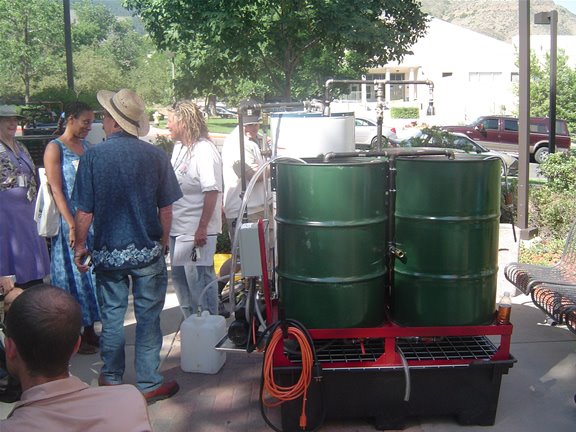

I just got back from this conference in Golden, CO organized by Girl Mark, Graydon Blair (of Utah Biodiesel Supply), John Meuser (at the CO Sch of Mines) and others (see http://b100.org for info). It was great and I learned a ton- will try to summarize as much as I can, but a lot of the presentations will be posted on utahbiodieselsupply.com pretty soon. If you have specific questions, I will try to answer them, but I missed a lot of the sessions.. You could also google the folks listed below to get in touch with them...
In general, it was attended by 130 folks, including 2 from S. Africa! and one from Germany. It had a grass-roots feel- refreshing for a conference. Outside the building, there were a few processors on trailers- cool designs- check out the one ffbiofuels.com especially. I met some great folks, including Graydon Blair of Utah Biodiesel Supply, who is a wonderful guy and his is my favorite source of all things biodiesel. My favorite presentation was Jennifer Radtke's story of the creation of Biofuels Oasis, a biodiesel fueling coop in Berkely. It's a worker and women owned business, and they bill themselves as an anti-gas station... meaning that it is very personal and service oriented- with love seats, and organic food, and fuel-filter changing workshops. She's also published a zine-book about the creation of the coop, which you can order from her at: biodevas@biofueloasis.com
I'm not gonna try to remember everything here.. also, Graydon has a nice blog entry about the conference complete with some great photos at: http://www.utahbiodieselsupply.com/blog/
I'm posting a few photos of some nice processors on trailers that were on display. One is by students at the CO School of Mines (Jon Meuser), and another is by flyingf fuels, available at b100supply: http://www.b100supply.com/index.cfm?fuseaction=Product.display&product_id=112
- a really nice set-up. Another blog with conference description: http://climateprotectioncampaign.typepad.com//cpc/2006/07/biodiesel_confe.html
The top 2 pics above are of a processor by Flying F Biofuels, and the 3rd is by Jon Meuser and friends at the CO School of mines. Both looked really nice!
Here is a list of the presentations:
- Intro to biodiesel
- Biodiesel Coop experiences in a nutshell. Alan Pryor, Berkeley Biodiesel Coop and Alameda Biodiesel Coop, Jason Burroughs, Austin Biodiesel Coop
- Disposal of Sidestreams. Matt Rudolf, Piedmont Biofuels, Pittsboro, NC
- Case Study: Yoderville Biodiesel Coop, Steve Fugate
- Methanol Recovery. St Louis Biofuels Club, Terri Zeman and Maud Essen. Find her on infopop forums- see pic on utahbiodieselsupply conference blog
- Liter batch demos (Steve Richer and myself)
- Small producer and Farm plant discussion. Frankie Lind, Pogoil, Brookesville, MD, Chris Jude, Appalachian State biodiesel poject in NC, and farm biodiesel plant project in Carnation, WA (Full-Circle Farms), Rob del Bueno, Vegenergy.com & Southern Alliance for Clean Energy, Atlanta, GA
- Educating the Local Community. Netaka White, Vermont Biofuels Association, Jennifer Radtke of backyardbiodiesel.og and Biofuel Oasis, CA, and myself
- Quality Control Factors for Homebrewers. John Bush, Boulder Biodiesel, Boulder CO
- A Club, Not a Coop: St Louis Biofuels Club. Maud Essen, Terri Zeman
- Biodiesel Distribution Experiences: Producer to End User. Kai Curry, Biodiesel Blue Distribution and Fryaway coop, Minneapolis, MN. Gretchen Zimmerman, Biofuel Oasis, Berkely CA.
- Case Studies of Grant-funded Educational Programs. Paul Feather and Chris Jude, Appalachian State University Collaborative Bioidiesel Project, Boone, NC, and Matthew Steiman, Wilson College Biodiesel Project, Chambersburg, PA
- From Seed to Oil: Oilseed crops and oil extraction technologies. Sam Anderson, BioFuel Technologies,LLC in Denver.
- Biodiesel 101 and Biodiesel Calculator Software presentation. Graydon Blair of Utah Biodiesel Supply in Salt Lake City UT, and Rick Harrison of Omahabiodiesel.com, Omaho, NE
- Gas Chromatography Testing of Biodiesel. Bob Armantrout, Rocky Mountain Biodiesel, Berthoud, CO.
- Cold Weather Strategies for Biodiesel Users and Homebrewers. Tom Judd, Coloradobiodiesel.com, Kai Curry, Biodiesel Blue Distribution, Minneapolis, and Steve Fuguate, Yoderville Biodiesel Coop.
- Sustainability: Where does your biodiesel come from? Gretchen Zimmerman, Biofuel Oasis, Bereley, CA.
- Homebrewing regulations and excise tax case studies: Nebraska, Pennsylvania, Utah. Rick Harrison, Omaha PSD Club, Matt Steiman, Wilson College Biodiesel Project, Graydon Blair, Utah Biodiesel Coop.
- Working with Volunteers. Matt Rudolf, Piedmont Biofuels, Pittsboro, NC and Maria 'Mark' Alovert, Berkeley Biodiesel Coop, and Women's Biodiesel Internship, Oakland CA
- Biofuel Oasis: Creating a biodiesel station. Jennifer Radtke, Biofuel Oasis.
- The Biodiesel community online: strategies about biodieselcommunity.org and the forums. Graydon Blair and Girl Mark.
- Oil collections. Steve Fugate of Yoderville Biodiesel Club and Frankie Lind, Pogoil, Brookesivlle MD.
- Homebrew Quality Control and Quality Testing. Girl Mark
- Case Study: The Story of Piedmont Biofuels. Matt Rudolf.
- Algae. Jon Meuser of Colorado School of Mines.
Subscribe to:
Posts (Atom)